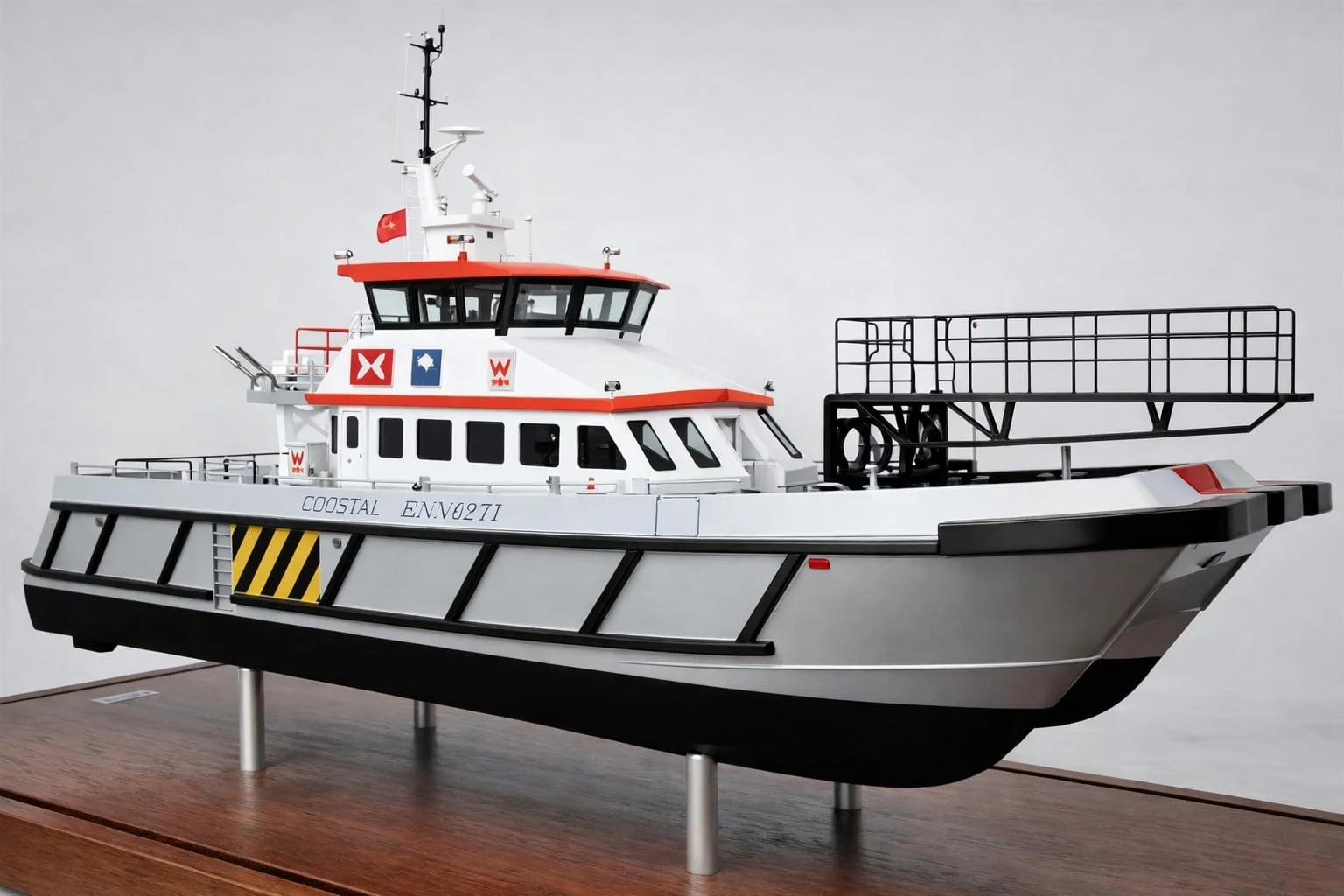


There’s a moment at almost every maritime exhibition when the crowd drifts towards the same stand, and it’s rarely the one with the biggest screen. It’s the one with a ship sitting on a table. A marine ship model has a strange pull. Even people who have never set foot on a deck lean in to look at the tiny lifeboats, the mast platforms, the ladders running down the hull. Shipbuilders know this, and it’s why models have been part of the trade for as long as ships have been designed.
But a good model is far more than a souvenir. It’s a piece of communication, and sometimes a piece of engineering. Here’s how they’re made and why people still commission them.
Where ship models came from
Long before computers, shipwrights built half models to work out hull shapes and to show clients what they were paying for. A carved wooden hull could be studied, sanded, corrected and approved in a way that flat drawings couldn’t manage. Some of those old models survive in museums today and are still admired for the precision of their lines.
The habit stuck. Modern yards work with digital hull forms and structural models, yet they still order physical versions for boardrooms, launch ceremonies and delegations. The reason hasn’t changed. A ship is a huge, complicated object, and a scaled copy is the fastest way to help people see it as a single, understandable thing.
Who uses them today
The list is longer than you’d think. Shipyards use models in tender presentations to show a proposed design to a prospective owner. Shipping lines keep fleet models in their lobbies and meeting rooms. Port authorities use them alongside terminal layouts to explain berth arrangements. Naval and coast guard organisations display them in institutions and training centres. Maritime academies use them so cadets can identify parts of a vessel before boarding a real one.
Museums and heritage groups form another important customer base. They tend to be the most demanding, because historical accuracy is non-negotiable and every rope, deck plank and cannon has to be right.
How a model is actually built
The work starts with drawings: general arrangement plans, hull lines, deck layouts and profile views. Without them a maker is guessing, and guessing shows. From there, the hull is usually formed by CNC machining or hand carving in wood or dense foam, then sealed and reinforced with resin or fibreglass so it stays true over the years.
Superstructures are built up separately. Bridge wings, funnels, deckhouses and cranes are cut, assembled and fitted. Tiny parts, such as railings, ladders, hatches and davits, may be produced from etched brass, printed resin or hand-bent wire, depending on the scale and the level of detail required. Then comes painting, which is slower and more skilled than it looks. Hull colours, boot-top lines, anti-fouling red, draft marks and funnel logos all have to match the real vessel.
Finally, the model is mounted on a base, sometimes with a simulated waterline. Full-hull versions sit on stands so that the underwater shape is visible, while waterline versions come with a sea surface made from tinted acrylic or textured resin.
Time is worth mentioning here. Paint needs to cure between coats, glue needs to set, and lighting has to be tested before the case is closed. A detailed model of a large vessel can easily take several weeks, and rushing any stage tends to show later as a chipped edge or a crooked mast. If your event date is fixed, start the conversation early and share the drawings as soon as they’re approved.
The details that separate a good model from a toy
Experienced eyes go to the same places. They look at the deck equipment first, since winches, bollards, fairleads and mooring gear give away whether the maker has studied real ships. They check that the railing height looks right for the scale, that the lifeboats hang from proper davits, and that the anchors sit neatly in their hawse pipes.
Colour and finish come next. Real ships are painted in flat, slightly worn tones, not shiny toy colours. A model finished with a soft satin surface and subtle weathering looks convincing from a metre away, while a glossy one looks like an ornament.
Lighting adds another layer. Navigation lights, deck lights and cabin windows can be wired in so that the ship comes alive in a dim showroom. It’s a small addition that changes the mood completely, though the wiring has to be planned early because it has to run through the hull and be serviceable later.
Choosing a display and looking after it
A model deserves a proper home. Acrylic cases keep dust off and protect fragile masts, cranes and antennas from curious hands. Direct sunlight is the enemy, as it fades paint and makes some plastics brittle. Air conditioning is helpful, but damp coastal offices need care, since humidity can slowly lift paint or loosen glued joints.
If the model will travel to exhibitions, ask for a purpose-built crate with foam cut to the hull shape. It’s a small extra cost that prevents a broken mast on the first trip. Cleaning should be gentle: a soft brush or a light blast of air, never household sprays. If a part does come loose, keep it safe and ask the maker to refit it, rather than reaching for whatever glue happens to be in the drawer.
How to decide what you actually need
Before commissioning, be honest about the purpose. A model meant for a lobby can be beautiful and slightly simplified. One meant for a technical presentation may need accurate piping runs on deck, working cranes or removable deck sections so people can see inside. A museum piece needs research and documentation. Each purpose changes the budget and the timeline.
It also helps to look at finished work from specialists before you decide. A well-built marine ship model from a maker who understands both engineering drawings and finishing will look convincing at arm’s length and hold up under close inspection.
Final thoughts
Ships are built over years, cost enormous sums and are seen by most people only from a distance. A model brings all of that within reach. It helps an owner picture the vessel, helps a student learn its parts, and helps a yard win the confidence of its customers. If you’re planning to invest in a marine ship model, spend the time on drawings, scale and finishing. Those three things decide whether the result becomes a proud centrepiece or something quietly moved into a storeroom.